

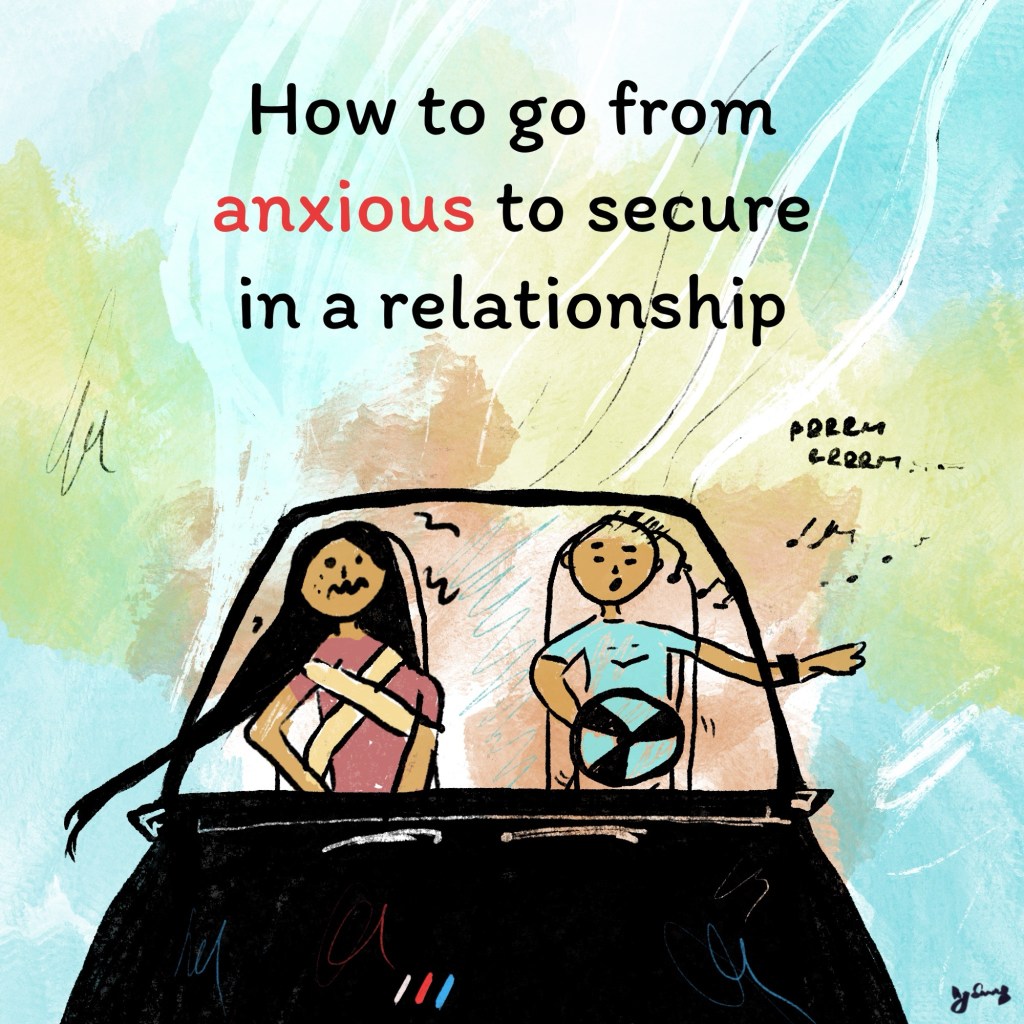
The anxious attachment spiral
I want you to visuallize the following scenario.
You meet someone new. You like them.
And guess what? They like you BACK.
Butterflies!
Life is a bliss, you’re in heaven. The relationship feels fresh and intoxicating, and suddenly your brain goes on vacation from all your usual worries. You’re just ENJOYING it.
All you can think about is when you’ll see them again.
Everything seems brighter, easier, just better with them. Problems? Gone. Sadness? Nonexistent. You can’t even remember the last time you were upset.
It’s like the world has disappeared and right now, you couldn’t care less about the future. Even the thought of things ending doesn’t bother you, because you can’t think that far ahead! You’re too busy living in the now.
You’re unattached. For now.
But as time goes by, you catch real feelings for this person. You fall in love. And then things become a little bit complicated.
You need to be around them more and when you’re not, you get uncomfortable. A quiet fear creeps in: What if they leave? What if life goes back to “normal”?
Suddenly, this person starts holding power over you. They start dictating your emotions.
When they’re happy, you’re happy. When they feel bad, you spiral down.
You start clinging on to them, wanting all their time, getting jealous when they mention other people!
That’s when the spiral begins.
You’ve become anxiously attached.
Anxious Attachment Explained
The idea that infants form emotional bonds with their caregivers has been around in psychology for centuries. But in 1958, British psychologist John Bowlby gave this idea structure when he developed attachment theory.
What is it exactly?
Bowlby defined “attachment” as the psychological bond that forms in early childhood between a baby and its parent.
For a child, attachment is about survival. When the baby feels scared, unsafe, or in need of comfort, it activates attachment behaviors designed to pull the parent closer, things like:
- crying,
- clinging,
- and seeking physical closeness
Over time, the way a parent responds to these signals shapes the child’s beliefs about relationships. Bowlby called this the creation of internal models, mental templates for how love, care, and connection should work.
And these templates don’t just guide childhood- they influence relationships for the rest of our lives.
To test his theory, Bowlby and his colleague Mary Ainsworth designed a groundbreaking experiment known as the Strange Situation.
Here’s how it worked: infants were repeatedly separated from their caregivers and then reunited.
Psychologists carefully observed how the children reacted, and from this, they identified four distinct attachment styles:
- Secure – The child trusts that their caregiver will return and meet their needs, so it confidently explores its environment. While apart, the child may feel distressed, but once reunited, they’re easily comforted and quickly go back to exploring their environment.
- Insecure – Avoidant attachment – The child who is left out, tries to downplay their need for comfort. When the parent returns, the child seems indifferent to their presence or absence and may avoid or ignore them. It returns to playing as if the separation never occurred.
- Insecure – Anxious attachment – Due to the high anxiety when separated, this child doesn’t want to explore its environment. When the parent returns, it seeks physical closeness and struggles to calm down. To prevent their parent from leaving again, these children start monitoring closely the parent and become hyper aware of any changes in their presence and moods.
- Insecure – Disorganised attachment – The most complex type. These children display contradictory behaviors: they want comfort but fear approaching. Because they don’t know how to approach their parent, they sometimes freeze. Or approach, but pull away. They display a mix of anxious and avoidance behaviours.
What Bowlby and Ainsworth revealed was powerful: the attachment style we develop as children doesn’t just vanish.
It becomes the foundation for how we connect with romantic partners, friends, and even colleagues later in life.
How Anxiously Attached People Act in a Relationship
If you feel overly dependent on your partner, know this: you’re not alone.
Anxious attachment is one of the most common insecure attachment styles. And if you have it, your relationships often feel like an emotional rollercoaster.
You may have it if you:
- Need constant reassurance that your partner still loves you;
- Don’t feel good doing your own things when they are not around;
- Have weak boundaries and agree with everything to avoid conflict;
- Feel waves of anxiety when they don’t reply or call back quickly;
- Constantly fear they would leave you;
- Interpret the smallest signs of distance as a sign they don’t like you anymore;
- Overreact in a conflict with disproportionate anger;
- Replay conversations in your head;
- Obsess over the relationship;
- Struggle with trust and always think they might cheat on you;
- Act clingy – excessively call, text and make plans to ensure you definitely spend time together;
- Try to make them jealous;
- Behave provocatively just to test the relationship.
If you recognise yourself in this, keep two things in mind:
1. this is NOT how securely attached people act in a relationship
2. you are sabotaging the relationship by acting toxic
Acting jealous and possessive towards your partner is a ticking time bomb – eventually, the relationship will crack under the pressure.
The good news is that attachment styles aren’t fixed in stone. And you can start working on how to shift from anxious to secure right away.
First of all…how securely attached people act?
Securely attached people are able to keep their relationships balanced with a healthy mix of intimate and independent behaviours.
This keeps them and their partner happy.
They express their feelings openly and honestly, strongly trust their partner and trust that their relationship is going well.
These beliefs make them feel safe enough to explore life outside the relationship
They enjoy spending time alone, and they encourage their partner to do the same. This secure foundation makes the relationship feel stable instead of fragile. It allows both partners to grow as individuals and as a couple.
How to start acting secure in a relationship before you destroy it?
To overcome anxious attachment, you first need to understand where it comes from.
The cause of anxious attachment is a deep rooted fear of death by abandonment by your parent, when you were a kid.
This fear, once originating in childhood, has been carried out in adulthood.
But here is the thing: once you realise you can’t die as an adult if your partner leaves you, you will figure out that even if your partner does, you will survive and you will be just fine!
In fact, if your needs aren’t met, you can leave and find another partner!
And the second thing you need to realise is that you cling too much on your partner – every word, every text, every small change, while you should be focusing on you.
There are THREE main ways to escape the anxious attachment trap:
Exposure therapy
Start by deliberately spending time alone.
Instead of waiting for your partner to ask for space, take it yourself. Put your phone away and engage in activities you’re passionate about.
It is highly unlikely that your partner likes everything you like. What do you love doing that your partner doesn’t?
Is it:
- car racing;
- watching cooking shows;
- building Lego models;
- belly dancing;
- reading horror novels;
- playing quiz games;
- hiking;
- shooting sunsets by the sea?
The list is endless. The only thing you need to figure out what excites YOU.
Now, here’s the important part: once you start doing these things on your own, pay attention to what happens.
Are they still there when you return? Yes.
Are they happy to see you? Most likely.
Do they check in on you while you’re away? Eventually.
Do they still love you while you’re apart? Most probably they do.
Once you start experimenting with intentionally pulling away from your partner, you’ll see that nothing bad happens when you create space. Your partner doesn’t disappear, and their feelings for you don’t fade.
Little by little, you will realise you don’t have to cling to them, because they aren’t going anywhere.
They won’t love you less if you disappear for a bit, and will miss you even more.
Chill out
When life gets too heavy, your anxiety often spills into your relationship.
You may start clinging to your partner, not because you love them so much, but because you’re trying to escape the weight of stress and responsibilities!
If you notice you can’t feel secure unless you’re glued to your partner, that’s a sign you’re overwhelmed.
So what’s behind it? Maybe it’s:
- too much work,
- not enough free time,
- too much house chores,
- pushing yourself with strict diets or workouts?
How to stop feeling stressed and get balanced
Whatever the cause, the fix is the same: stop trying so HARD.
Maybe you have started taking yourself and life too seriously, so you need to chill out.
Take a day or too off work and say “No” to any non – essential responsibility. Unless you have kids or parents you have to take care of, you don’t have to be available for anyone else.
Once you’ve said NO to “responsibilities”, do stupid things:
- Take a shower and sing as loudest as you can;
- Sit on the floor and sculpt weird plasticine animals;
- Go buy ice cream and wander in town without any idea where you’re going;
- Spend a whole day as mindlessly as possible;
- Binge comedy shows, order pizza and a chocolate soufflé on top;
- Buy a video game and spend a couple of days gaming just because.
Do this for a couple of days and watch your anxiety disappear.
The psychology behind this is very simple.
You take the pressure off.
When you take the pressure off, your nervous system relaxes. That’s why your best move is to act like a complete slacker for a few days.
Writers use the same trick when stuck. They force themselves to deliberately write the WORST thing that they can think of. But what happens next is creativity starts flowing back!
Study other people
One of the quickest ways to rewire your thinking is to look at how secure people handle the same situations that make you spiral.
Let’s take an example. Your partner goes to a concert without you.
If you’re anxiously attached, the thoughts might quickly snowball into:
“They’re having fun without me, they don’t need me anymore.”
“What if they meet someone better there?”
“What if they get drunk and cheat on me?”
Now, here’s what a securely attached friend of mine said when I asked her how she would react:
“Yeah, I’d be jealous – jealous that it’s not ME at the concert having fun!”
Do you see the difference in secure peoples’ thought process?
No doom, no paranoia, no imagined betrayal.
Secure people don’t deny feelings like jealousy, they just don’t blow them out of proportion.
The truth is, changing your attachment style is possible once you get rid of your fear of abandonment and develop strong self-esteem.
And if you catch yourself attaching too much, too soon, it might be because you’re over-investing in the relationship. And that’s fixable too.
Want to dig deeper?
You might want to learn how to get over any breakup in just 30 days.
See also: How to stop being bored in a relationship
How to develop superior social skills
How to deal with being broken up with
TheThinkAbout is a website based on psychology in practice and experience.
Like the articles? Subscribe to never miss anything.
Your contribution matters! If you find this website helpful, please support our work. Thank you for visiting!
 The think about
Leave a reply to Mollie Player Cancel reply