
Dealing with condescending people
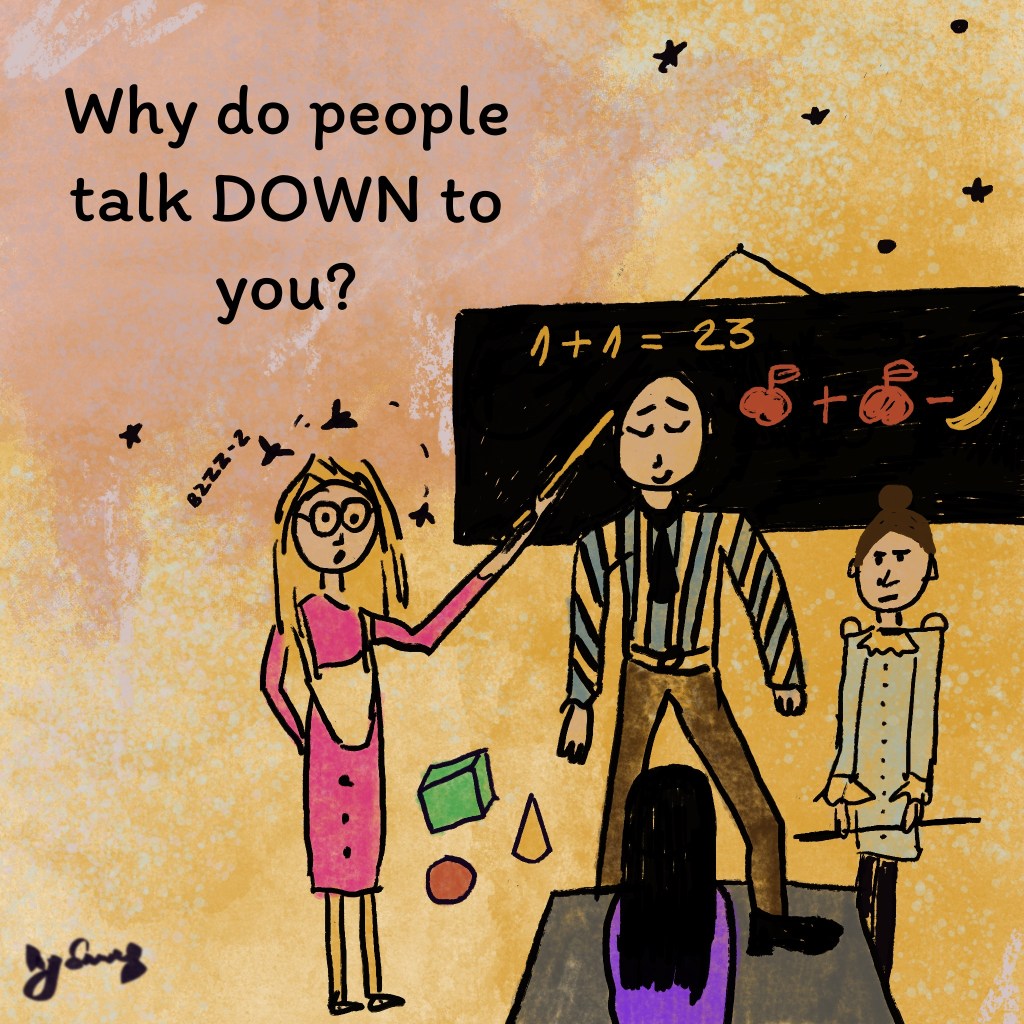
Ever felt like people talk to you as if you’re a four-year-old?
It could be your family, it could be your partner, it could be your friends. It could even be people you’ve just met – sometimes even complete strangers.
Seems like you’re attracting know-it-alls all the time.
They can’t seem to resist telling you what to do or how to do it, even when you never asked. If you sense that people often act superior around you, it’s time to read this article.
But what does it actually mean “to talk down” to someone?
It might be someone giving you unsolicited advice. Or maybe they judge your opinions or actions. They could be making jokes at your expense, dismissing your thoughts, or expressing low expectations of you.
Basically when someone talks down to you, they try to dominate you in a way that speaks: “I’m more important than you.”
Your frustration is completely valid. Talking down to someone is deeply disrespectful. It’s never justified.
Nobody is inherently worth more than anyone else. Sure, someone may have achieved more than you, but that doesn’t make their value as a person any greater. And even if someone’s accomplishments are significant, (a better job, a bigger house, a larger family), it doesn’t give them the right to rub it in your face.
Bragging and judging stem from ego, and we’ve already discussed in this article why feeding your ego is toxic.
Six reasons why people may try to act superior to you
Let’s get one thing straight: when people act superior, it’s almost never about you – it’s about them.
Everyone chooses how they respond. Even if something you did triggered their reaction, their choice to belittle or dismiss you is a reflection of their own insecurities, frustrations, or ego battles.
Always remember: your feelings are valid, but your reactions are not automatically justified. The power lies in how you choose to respond, not in how they treat you.
That said, sometimes we unknowingly make it easier for people to talk down to us. If you notice any of the following behaviours, it’s time to correct them, because they don’t serve you, and they quietly signal others that it’s okay to take the upper hand.
You project low self-confidence
Insecurity is often seen as a weakness. In the animal kingdom, the weak are preyed upon, it’s just nature’s way.
If you project low confidence, you make yourself an easy target for people with exploitative tendencies. Such people thrive on tearing others down to build themselves up.
They’ll latch onto you and take every chance to talk to you like you’re a stupid child. All while trying to make themselves shine.
You overshare your struggles and failures
Many low-confident people struggle with oversharing. Why is that?
Becaaaaaaaause……ta-da-da-daaaaaam….they can’t make small talk! They have a hard time thinking of casual conversation topics.
If you relate to this, fear no more. Check out this article, How to become a master at socialising for helpful tips.
If you’ re used to thinking “I hate small talk, it’s so superficial!”, consider this: Small talk is “invented” for a reason. It allows you to connect with others without revealing personal information that they could use against you.
It’s not wise to let just anyone get too close. But does that mean you should avoid talking to people altogether?
Anxious people may share personal details to fill the awkward pauses. Unfortunately, these details often aren’t things they’re proud of. When discomfort kicks in, many act small or vulnerable, hoping to gain sympathy or get people off their backs.
An example – many talk about their relationship problems with their colleagues. Are you guilty of doing this?
Then you might have taught others that you see yourself as someone who struggles to get things right and constantly needs guidance.
You don’t put people in their place
When someone tries to put you down, you need to act. Set a firm boundary and make it clear that their behavior is unacceptable. Show them where you stand and remind them where they stand.
It’s similar to the animal kingdom – when someone tries to bully you, you have to stand up for yourself to send a clear message.
Of course, I don’t mean attacking literally. But the point is, you need to become your own advocate and your own superhero.
You talk down to yourself
You think acting small makes you a better person? A small ego can be just as unhlealthy as an exaggerated ego.
Talking down to yourself is another form of ego at play. We’ve already discussed why letting go of your toxic ego is essential to grow and become the best version of yourself.
You are making them feel a bit too comfortable around you
When you empathize with others, listening intently with wide, doe-like eyes, nodding, and smiling at everything they say, you make people feel very safe around you. Over time, some of them may become a little too comfortable.
Combine this with low confidence and acting small, and there you have it.
They might start interrupting you, dominating the conversation, and treating you as if you just graduated kindergarten.
Finally…because people need to feel important
It didn’t start with you. When people feel inadequate, they often try to gain a sense of power by dominating others.
The ONLY working way to stop people from overpowering you
My mom once said something wise: “You can’t control what people say behind your back, but you can make them respect you to your face”.
The most important thing you can do for yourself is to develop a winner’s mindset.
Positive self-talk alone isn’t enough. Simply repeating affirmations won’t help if, deep down, you know you don’t like yourself. Do you know what “cognitive dissonance” is? It’s when you hold two contradictory beliefs at the same time.
Your brain can’t handle it. It will always try to resolve cognitive dissonance by strengthening the dominant belief. If your core belief is that you’re not good enough, your brain will reject the positive affirmations and reinforce the negative thought instead.
This will only leave you feeling more inadequate. The only real way to empower yourself is:
To make yourself proud.
When you feel proud, how could anyone talk down to you?
Take my story as an example:
I once overcame my fear of driving and the shame of not being skilled behind the wheel. I clenched my fists, got in the car, and took a 5-hour solo trip. I was terrified and thought I wouldn’t make it. But guess what? By the end, the insecurity disappeared.
When you feel proud of yourself, everything else falls into place. You naturally set boundaries, become assertive, and carry yourself with confidence.
It all stems from one thing: realizing your worth. And to realize your worth, you need to actually
do
the
actions
that would bring you the desired self-growth results.
Get rid of every bad habit that makes you feel weak. If you need to quit smoking, then quit. If you’re unhappy with your appearance, work on improving it. If you struggle to stay calm when triggered, focus on building rock-solid self-control.
It’s your actions—not words or affirmations—that will truly transform how you see yourself.
When you radiate confidence and believe in your worth, nobody will dare talking down to you. Instead, they’ll secretly wonder how you do it and will respect you so much more.
And if someone does try to belittle you? You’ll laugh at them! Their opinion won’t matter anymore.
So start today:
- Read about power.
- Read about how to make a working plan to achieve your goals and dreams.
- Check real failure to success stories to get inspired to act.
- Learn how to not lose motivation in the process.
- And finally some hacks that will help you persevere before the first results show up.
Before long, I’m confident you’ll have your own success story to share with us.
More things to think about:
How to have a colder personality
The ultimate guide on developing charisma
How to become a closed book for people
Bored with your routine? See how to make your life interesting
5 books on power and control to read
TheThinkAbout is a website based on psychology in practice and experience.
Like the articles? Subscribe to never miss anything.
Your contribution matters! If you find this website helpful, please support our work. Thank you for visiting!
 The think about
Leave a reply to Diane Ellis Cancel reply