

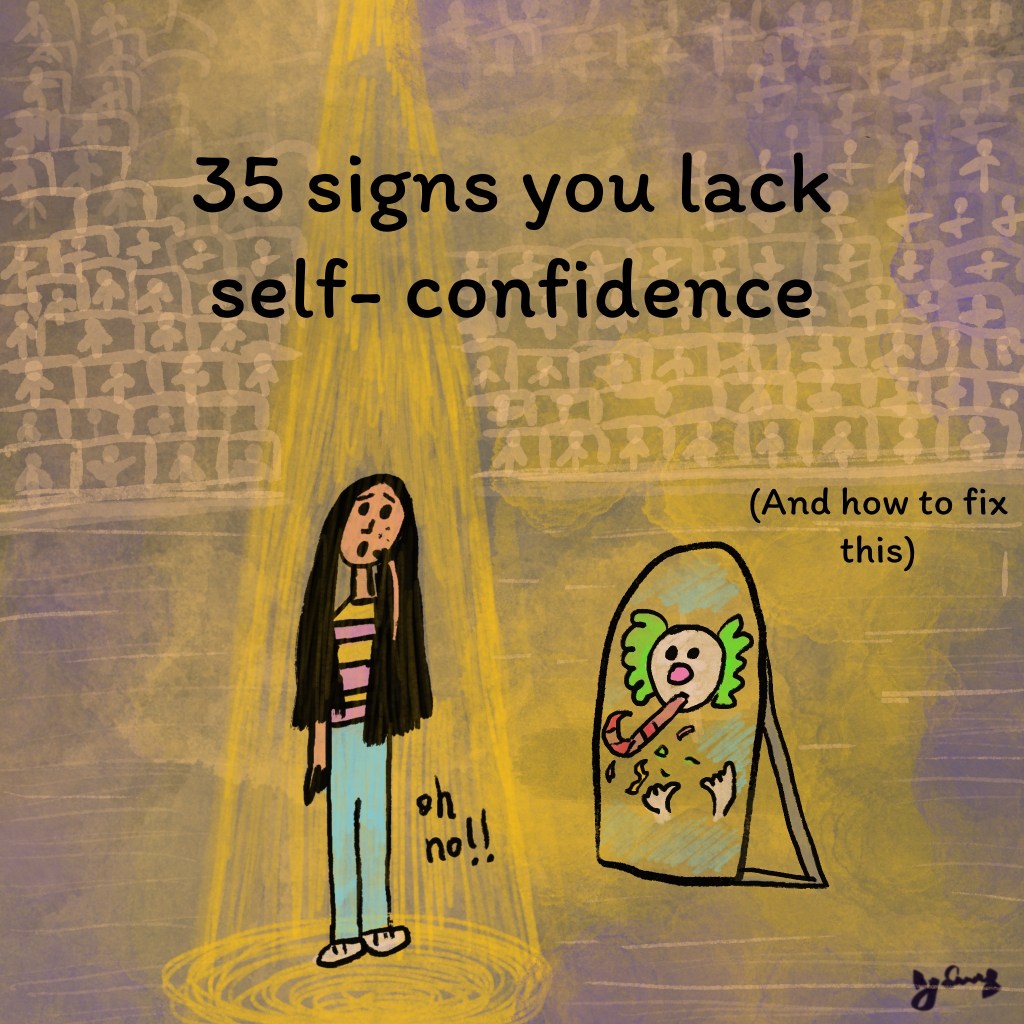
Do people tell you this a lot?
If you are reading this article, my guess is you’re tired of hearing people say: “You need to be more confident”, “You don’t love yourself enough”, “You should believe in yourself more”.
If you hear this often, don’t dismiss it.
Low confidence is not difficult to spot.
It shows on your face and affects every area of your life negatively. Low self-esteem makes you choose the wrong romantic partners, let people walk over you, miss opportunities and hinder your self-development.
Because you don’t believe you can achieve your goals.
“I am extremely insecure. Can insecurity be healed?”
Before anything else, let’s clear this up: low self-confidence can absolutely be fixed, no matter if you are 30, 40, or 90 years old.
You won’t become confident in a day, but with persistence, you will soon become a strong, powerful, and assertive person. Healthy self-esteem will make a big difference in your life, I can assure you of that.
Without further ado, let’s check the features of low self-esteem.
35 obvious signs you lack self-esteem
- You have bad posture—rounded shoulders, head down, a “droopy” walk, always having your arms crossed when you talk to people, and being uncomfortable with eye contact.
- You mumble a lot, and people often ask you to speak up or repeat yourself.
- Or you avoid talking at all.
- People often interrupt you or get distracted when you talk. They probably get distracted because your tone of voice is low and monotonous.
- You constantly apologize for things, even when it’s not needed.
- You prioritize everyone’s judgment over your own.
- You give gifts and do favors frequently because you believe you have to do things for people to make them like you.
- You “understand” bad behavior so much that you put up with it because “you see the other person’s point of view”.
- You save the worst for yourself—e.g., food, seating, etc.
- You give far too much credit to other people’s opinions.
- You get very upset when people criticize you.
- You are often told, “You are overthinking this”.
- You have trouble cutting off people you don’t like.
- You alter your personality to match the person you are interacting with.
- You are afraid to ask people to do things for you.
- You often hide because you feel the world is out to get you—that everybody either attacks, wants something from you, or wants to do you harm.
- You can’t stand up for yourself when you are verbally attacked.
- You get anxious, angry, and frustrated with people, so much that you say, “I hate everybody!”
- You avoid confrontation at all costs because you can’t advocate for yourself.
- You compliment others but talk down to yourself.
- You tolerate toxic behaviour and are unable to walk away from abusive relationships.
- You always second-guess yourself, until another person “confirms” you’re right.
- You struggle to self-validate.
- You are over-focused on other peoples’ lives.
- You can’t say “no” without feeling guilty.
- You worry what people think of you.
- You constantly ask others for advice, opinion, approval or validation for everything you do.
- You feel like other people have control over their lives and you don’t.
- You get envious of other people and present yourself a victim.
- You act clingy in a relationship.
- You constantly blame yourself, criticise yourself and feel unworthy.
- You are full of fear of the unknown and try to control everything.
- You overshare personal details.
- You can’t be single.
- You don’t enjoy your own life and try to mimic other peoples’ lives.
The hidden effects of low self-confidence
People with self-esteem issues unintentionally wave a big white flag with the slogan: “You can disrespect me, and I’m okay with that!”
Do you know what most people will do?
They will take advantage of this.
Most people are not super self-confident themselves, and the moment they sense someone is less confident, they involuntary (but sometimes on purpose), try use this as leverage to raise their own self-esteem.
Because it’s easier than putting real effort.
So what happens is: on one hand, you put yourself down, show other people that it’s okay to be mistreated, allow bad treatment, and then start resenting the world for mistreating you.
While it was your low self-confidence who enabled others to disrespect you.
You may get dark thoughts that everyone hates you, try to bully you, have some kind of problem with you, or that you’re constantly misunderstood. But the problem isn’t that people are against you.
The problem is that you have low self-esteem.
I want to reassure you that this can absolutely be repaired. We humans are social creatures. So if you want to feel good and not anxious around people again, let’s work on building your healthy self-esteem.
Where do self-esteem issues come from?
Low self-esteem is rooted in negative beliefs about yourself.
It all starts with negative thoughts.
These often originate in childhood, if you were neglected as a child, but not necessarily. As adults, we also go through traumatic experiences that create a negative image of ourselves.
You probably failed at something in the past—e.g., you embarrassed yourself in front of your crush and they turned you down, or you struggled at school, or someone mocked or criticized you, or you had a toxic relationship that ruined your self-confidence.
Bottom line: what happened to you made you see yourself in a negative light.
Then, when you constantly replayed these negative thoughts in your head, they became part of your belief system.
Finally, you started acting according to your belief system, and you kept reinforcing that you were:
- “unattractive”
- “dumb”
- “slow”
- “too shy”
- “socally awkward”
- “incompetent”
- “lazy”, etc.
by not proving yourself wrong. The solidified belief that you are “less” or “flawed” caused you to lose confidence in yourself.
How to prove yourself wrong and regain your self-confidence
You read that right. I said “re-gain”.
As babies, we were all confident. If we weren’t confident, we would have never learned to walk and talk.
We would have been so embarrassed by ourselves after the first 100 failed attempts that we would think, “Nope, I suck at this. I should just quit altogether, because I’m obviously bad at it.”
So, depending on the area in which you’re lacking confidence, I want you to start proving yourself wrong right now.
If you feel bad because you think you’re unattractive, then don’t feel bad about it – just make yourself attractive. Check out this complete guide on how to do it. You have literally no excuses in today’s world, where people have the resources to completely change their physical appearance.
If you lack confidence because you are bad at something (e.g., you can’t drive, or you’re a bad driver, or can’t park your car properly), start practicing that thing every single day until it’s not a problem for you anymore.
If you lack confidence because you’re bad at conversations and can’t get a date, start working on developing your social skills. Socializing shouldn’t be a torture – check out this guide on how to start with ease.
If you lack confidence and let people walk over you, ask you for favors, and take so much of your time, money, and energy, learn how to be more assertive.
The Blackboard experiment
I’ll tell you an extremely simple, yet totally effective way to raise your confidence.
Buy a blackboard (or a whiteboard, if that matters), and hang it on the wall.
For the next 30 days, I want you to:
- Commit to challenging the false belief that causes your low self-confidence; (e.g. “I’m unattractive”, “I’m dumb – I don’t know most European countries on the map”, “I can’t get a better job”, “I’m lazy – my apartment is a mess”, etc.);
- Do something brave that gets you out of your comfort zone challenging the false belief (e.g., go to a job interview, go on a blind date, drive alone from point A to point B).;
- Every night before bed, write the thing you did that made you proud of yourself on the board.
You need to do this for 30 days straight, which means you will need to have something to write on your board every day.
Why the scariest things turn out to boost your confidence the most?
When you think of things that push you out of your comfort zone, I advise you to think of something really scary.
I’ll give you an example.
I was a new driver. I had maybe two hours of driving completely alone.
I was extremely anxious to drive. I literally started getting nauseous the second I got into the car. I wanted to vomit.
I was so stressed, I broke my front mirror by throwing my bag in the air on the front seat because my brain didn’t even think I should open the other door, take my time, leave my things, and prepare for a ride.
My brain just completely blocked when I had to drive.
This made my confidence completely sink.
So I decided I would take the car for a ride to my hometown. That was a five-hour drive. And not only that, I left in the dark to “avoid” the traffic.
I drove in pitch black, there was heavy fog, and it was raining cats and dogs! I could barely even see the road! And there was still traffic because it was the Christmas holidays.
But I drove slowly and attentively, and committed not to panic. Was it scary? Yes! But I had, kind of, gone so far, it was impossible to go back.
So I had to just deal with it.
And I did. I felt so proud of myself later. I was still not a professional at driving, but was I low-confident? No! Because I was doing the best I could to become better at it, and I was proud of myself for it.
And I knew that with every practice, I would eventually become better.
I hope you feel at least a little bit inspired to challenge yourself today and have your own story to share. So, what’s yours?
Read more on the topic:
Other ways to develop rock-solid confidence
How to develop your social skills from scratch
How to program your mind like a computer
Failure to success stories of famous people
How to NEVER give up when life gets tough
TheThinkAbout is a website based on psychology in practice and experience.
Like the articles? Subscribe to never miss anything.
Your contribution matters! If you find this website helpful, please support our work. Thank you for visiting!
 The think about
Leave a comment