
You never expect to be the villain
Here’s the tricky thing about being toxic: it’s one of the hardest traits to recognize in yourself.
Nobody wants to think of themselves as the villain.
Let me give you a scenario.
Say you’ve been struggling to find a healthy relationship.
No matter who you date, the pattern is the same – you feel unappreciated, you attract lazy partners, pushovers, or people you call “losers.” Eventually, the thought creeps in:
“I always attract toxic people”.
But here’s a hard question: what if the toxic one isn’t them… but you?
I know, it sounds ridiculous at first. But think about it. Is it possible that you’ve been complaining about your partners, while it’s YOU who’s been the toxic one?
How is it possible to be manipulative and not realising it?
Remember the last scene of A Beautiful Mind, when the main character suddenly realizes that nothing was what it seemed? It’s kind of like that moment of shock.
You thought your partner was neglectful or uncaring, while you were completely innocent. But what if, underneath it all…
you were being judgemental, jealous, controlling or pushy?
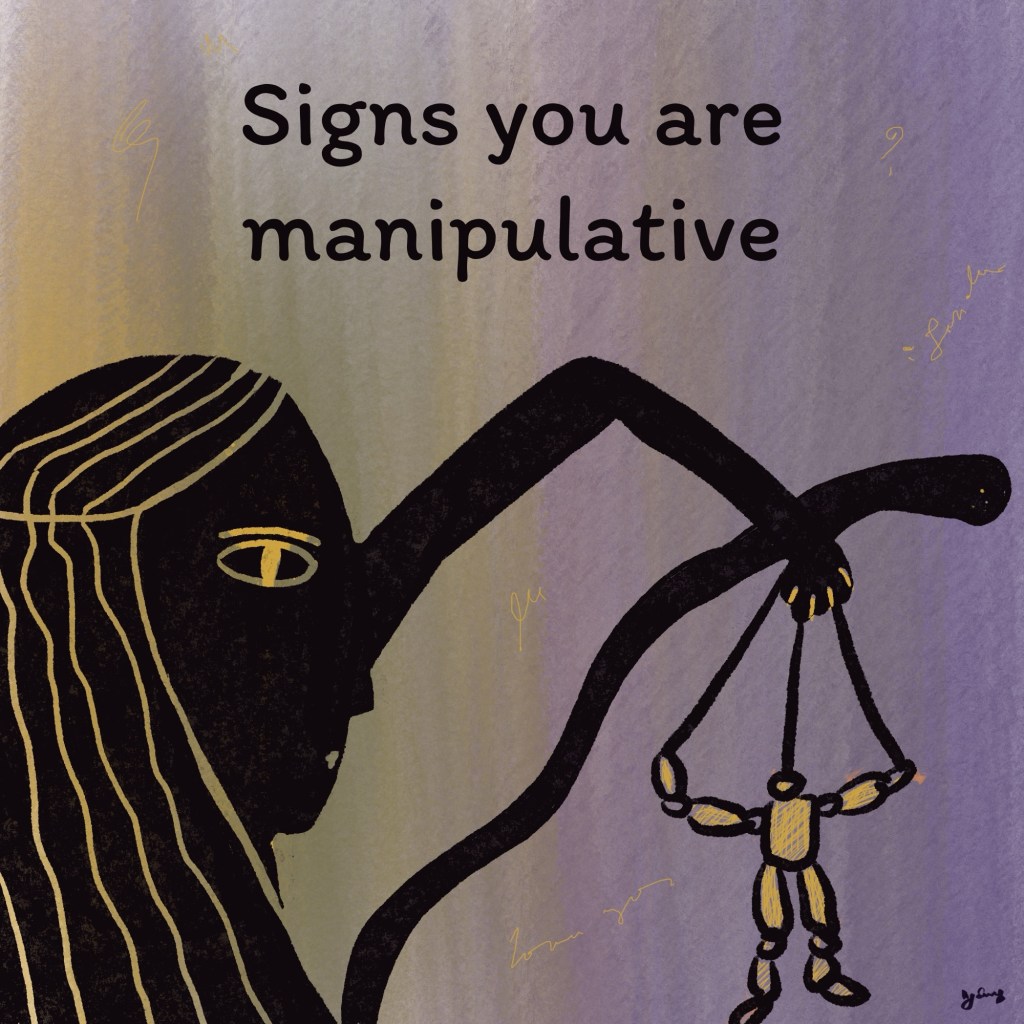
Those kinds of behaviors, whether you realize it or not, are manipulative. They’re attempts to influence or control the other person’s thoughts, feelings, or actions, all to keep power in the relationship.
If you recognize yourself here, don’t panic. Everyone has the capacity to be toxic.
The good news? Once you see it, you can change it.
Power is a basic human need, and sometimes manipulation sneaks in when we’re just trying to protect that need.
What Makes Someone Toxic Without Even Realizing It
If you lack strong boundaries and aren’t assertive, yet somehow always manage to get what you want, there is a high chance you have subconsciously developed manipulative traits.
When you don’t feel comfortable saying directly what you need, you often find “indirect” ways of getting it.
And those indirect ways… are usually manipulation.
In my article How to be assertive in love relationships, I explained what happens if you don’t assert yourself in your relationship. Check it out, it is a powerful guide on how to develop self-assertive skills.
Manipulation is a learned behaviour.
Children who grow up in unstable homes, especially with narcissistic or mentally unstable parents, often pick it up as a survival skill.
They learn that if they openly express what they want, they’ll be ignored, punished, or dismissed.
So they adapt. They hide their real feelings and figure out other ways to get their needs met:
Manipulate people into doing what they want.
That’s what manipulation really is – convincing someone to do what you want by making them believe it’s what they want.
It can show up through different tactics: : deception, guilt-tripping, gaslighting etc. (I’ve written a full guide on manipulation tactics and how to counter them, you can check it out here. )
So, if you think you’re a good person, but at the same time you:
- lack healthy boundaries;
- are a people-pleaser;
- aren’t assertive, yet mysteriously always get your way;
- were raised by narcissistic parents;
- or have been called “manipulative” by partners or friends…
There’s a strong chance you’ve developed manipulative traits without even realizing it.
How You Might Be Manipulating People Without Realizing It
Here’s the thing about manipulation: it doesn’t always look sneaky or malicious. Sometimes it’s just how you’ve learned to get what you want.
Let’s break down a few common ways people unconsciously manipulate others:
- When you want something, you’ll go to great lengths getting it
What does this mean?
Maybe you try to get under the skin of the person you want this specific thing from. This can be done unintentionally. By finding out all their likes and dislikes, you can either:
1) make them feel really good, so they want to do the thing you want
or
2) make them feel really bad, so they give in just to stop the bad feelings
If figuring out peoples’ needs and fears comes naturally to you, manipulating them can slip out without you even realizing.
- You see all possible scenarios and have plan B, C and D
Control freaks, listen up. If you can’t handle unpredictability, you probably over-prepare for every possible scenario.
If you can’t let go of control, you will inevitably need to manipulate people to behave the way you want them to. And you won’t even realise this.
- You know what motivates a person to make a decision
Here’s a powerful skill: if someone is logic-driven, you use facts. If they’re emotion-driven, you appeal to feelings.
That’s persuasion, but it can slide into manipulation if you use it just to bend people to your will. Are you doing this?
- You can make someone feel bad if they don’t do what you want
You can tell what makes a specific person weak – whether it is guilt, shame, frustration etc. If you know someone’s weak spots, you might trigger those emotions to sway them.
For example: Someone that you know struggles with feelings of unworthiness. And they don’t do something that you want. You won’t yell or nag. You would accept their decision… just give them a brief disappointed look.
This will trigger their insecurity enough to make them question their own decision and later change it, just to stop feeling bad about themselves.
- You have different personalities for different people
Are you a social chameleon? Do you blend into every group, adapting so well that everyone thinks you’re “just like them”?
You may realise you have friends from so different social groups, that they don’t have anything in common. But how come they all relate to you?
You may not realise that to establish a connection, you tailor yourself according to the person. You become what the person desires, their mirror.
The deeper reason you don’t show your authentic self might not fear that people won’t like you.
But to not risk losing power.
Subconsciously, your mind says: “If people don’t like me, I’ll lose influence. But if I mirror them, they’ll do what I want.”
This is manipulative.
What If You Realize You’re the Antihero?
Psychologists have a name for people with highly developed manipulative traits: Machiavellians.
Machiavellianism is part of the Dark Triad personality model, alongside narcissism and psychopathy. These traits describe people who are cunning, strategic, and opportunistic, willing to bend the truth with disregard if it is moral or not.
People who score high on Machiavellism tend to be willing to deceive or betray others if it serves their purposes.
Here’s the truth: even if you realise you have the capacity to manipulate others, that doesn’t automatically make you a villain. You don’t have to act on it.
In fact, there is another word for manipulation: Influence.
If you naturally know how to read people and spot what motivates them, you hold a powerful skill. Used selfishly, it can destroy trust. But used wisely, it can inspire, guide, and uplift others.
Then the question isn’t “Am I manipulative?” but rather: “Am I using my influence to control, or to empower?”
If your gift is being able to see through people and understand their true intentions, don’t waste it. Use it to build trust, spark change, and help others grow.
Do you know how to read people and know their true intentions? Learn about it here.
See more:
How to heal from narcissistic abuse
The secrets of irresistible people
Why the more powerful, the more attractive you are
Why some people succeed in life
How to tell if someone’s lying based on science
TheThinkAbout is a website based on psychology in practice and experience.
Like the articles? Subscribe to never miss anything.
Your contribution matters! If you find this website helpful, please support our work. Thank you for visiting!
 The think about
Leave a comment