

Are you working in a big organisation?
Let me tell you a secret: for the first eight years of my law career, I didn’t even know HR existed.
Fresh out of my master’s degree, I joined a small law practice. We were a tight team of five. No HR department, no “people operations,” no endless bureaucracy. Just us, our accountant, and the cleaning lady.
We knew our labor laws, we handled our interns, we trained them the way we wanted things done.
Conflicts?
Sure, they happened. But we solved them the old-fashioned way: by ignoring each other for a while and then hashing things out over drinks after work.
Brutal honesty, followed by a round of beers. Problem solved.
It wasn’t perfect, but here’s the thing, it worked.
Not once did I think, “You know what would fix this? An HR department!”
Years later, when I finally crossed paths with my first HR director, I realized just how different life is when you’ve got “Human Resources” hovering around.
And not in a good way.
This article comes from someone who spent years thriving in organizations without HR, and can honestly say the workplace was better off without them.
How the HR Department Was Born (and Why People Don’t Trust It Anymore)
According to HR Magazine, the very first HR department was created back in 1900.
John Henry Patterson, owner of National Cash Register Co., came up with the idea. The department’s job was simple: handle grievances, manage salaries, and make sure safety rules were followed.
Straightforward, right?
Of course, when a company gets bigger, someone does need to take care of the paperwork. Employee files, documentation, performance records… it makes sense.
But here’s the twist.
What started out as “personnel administration”, (the way it was actually called back in 1900), a supportive role meant to look after employees, slowly mutated into what we now call “Human Resources.”
And with that shift, the mission changed too.
Instead of being there to help workers, HR became the company’s front line for extracting as much as possible out of its people, on behalf of the employer.
It’s no wonder many people distrust HR today.
And for a good reason.
Over the years, they’ve steadily lost credibility in the eyes of employees.
HR is the Trojan Horse of Management
One of the biggest scams of the 9-to-5 work culture is the myth that HR is a bridge between management and employees.
On paper, HR looks like the hero of the workplace. They’re supposed to:
- motivate employees,
- resolve conflicts,
- increase employee satisfaction,
- carry employees’ concerns to management,
- provide the best working conditions,
- nurture talent,
- ensure equal opportunities…
Sounds amazing, right? Almost too good to be true.
That’s because it is.
In reality, it’s impossible for HR to truly serve both sides. Their paycheck comes from management, not the employees. And at the end of the day, they protect the company first, always.
Now, to be fair, not all HR professionals are villains.
Many enter the field genuinely wanting to help people. But once they face the harsh reality of corporate life, they either:
- Quit in frustration, or
- Accept the rules of the game – rules that have nothing to do with employees’ best interests.
And those rules? They’re all about protecting the company, minimizing legal risk, and squeezing more productivity out of workers while keeping them “happy enough” not to quit.
HR Doesn’t Have Real Power
Let’s be clear: HR cannot defend you if your interests clash with the company’s.
Why? Because HR isn’t some independent authority. They’re employees too, paid by the same company you work for.
Do you think HR decides your benefits, your salary bands, your performance bonuses, or even the team-building budget? No. Their role is to advise management, not to overrule it.
At the end of the day,
HR’s job is to help the company get the most work out of you for the least money possible.
HR Will Always Choose the Company’s Side
HR isn’t hired to be your therapist or best friend. They’re hired to protect the company from you.
Think of it like this: lawyers are the “bad cop,” HR is the “good cop.”
Both work for the same boss, just with different styles. Lawyers defend the company in court. HR pretends to care about your well-being, while taking notes to report back to management. In reality, it is their job to sniff potential dangers from afar.
Here’s the uncomfortable truth:
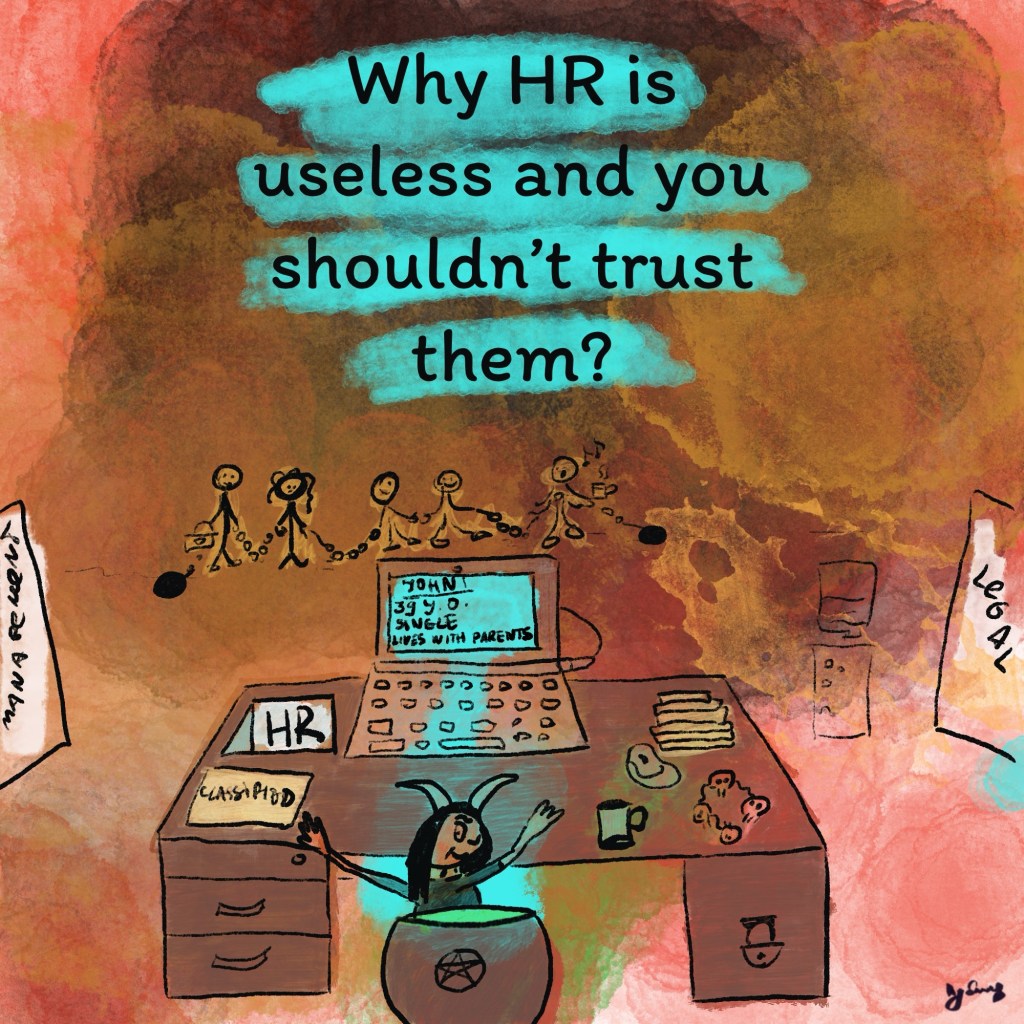
Everything You Share With HR Eventually Reaches Your Employer
I’ve worked close to HR and senior management. I’ve sat in those meetings. And I can tell you for a fact:
“Your secrets are confidential”
is the biggest career-killing lie in corporate life.
HR collects information like:
- your relationship status;
- your partner’s job;
- where you live;
- who your family is;
- your health status;
- who your friends at work are;
- even where you spend your holidays.
Why?
To assess how secure or vulnerable you are.
Will you ask for a raise? Are you likely to quit? Are you replaceable? HR feeds management that intel so they can make the most cost-effective decision, and it rarely benefits you.
Never, ever assume that HR is your friend at work.
HR Is Just a Messenger
HR isn’t a mediator. They aren’t psychologists. They’re messengers.
Their main job is to deliver management’s decisions in the most sugar-coated way possible.
- Someone’s getting fired? HR breaks the news.
- New policy everyone will hate? HR spins it as “opportunity.”
- Company wants to squeeze harder? HR wraps it in “team spirit” slogans.
HR’s Job Is to Sell the Company (Not to Help You)
Enter “employer branding.”
Sounds fancy, right?
It’s basically PR for the company, a way to lure talent in and reduce turnover. HR builds a glossy image of the workplace, no matter how bad it really is.
Good companies align branding with reality. But most? They gaslight their employees.
They:
- brag about “employee satisfaction” while buying the cheapest workstations.
- preach “one big family” while cramming you in windowless cubicles.
If companies were people, HR would be the smooth-talking gaslighter who convinces you abuse is “love.”
HR Is Often Incompetent at Hiring
One of the most debilitating things in a job interview is to be standing across an HR who asks: “How would you solve problems if you were from Mars?” and finding out they have no idea what your job actually entails.
What is the point, you might well ask, if they have having zero understanding of system engineering, coding, or accounting (or whatever role they’re hiring for)?
Some HRs have a psychology degree, so they can filter the people who have the right personality to fit in.
They’re filtering for “culture fit,” not competence.
Which is why critical roles often stay unfilled for months, HR is drowning in admin, but still gatekeeping technical candidates they don’t understand.
The Big Lie of “Anonymous” Surveys
Ever filled out an employee engagement survey? HR probably swore it was “anonymous.”
It isn’t.
These surveys serve two purposes:
- To give management flattering stats they can brag about (and use to secure bonuses), or OR
- to identify which employees are unhappy – and therefore “a risk”.
If you’re highly skilled, (in the “top 50”, “top 100” etc.), they might bribe you to stay.
But if you’re “ordinary”? Your dissatisfaction is seen as contagious. They’ll look for ways to push you out before your negativity spreads.
So Who Can You Actually Trust at Work?
If you’re dealing with workplace problems – a toxic coworker, unfair rules, or crushing workloads, HR should be the last person you turn to.
Nine times out of ten, you’ll regret it later.
Instead, consider safer options:
- A lawyer, (if you suspect your rights are being violated);
- A career coach, (to help you strategize your next move);
- An organizational psychologist, (if stress or conflict is eating away at you);
- An independant HR consultant/agency, (someone outside the company with no hidden agenda);
- A trusted friend;
- And finally…your own boss. Sometimes the most direct path is still the best one, as long as you approach it wisely.
Have you had unpleasant experiences with HR?
Do you deal with poor working conditions or company “gaslighting”? Share your story in the comments, your voice might help someone else going through the same.
Check out more articles:
How burnout at the workplace affects you
What makes someone “quiet quit” their work
I’m also dealing with relationship problems
TheThinkAbout is a website based on psychology in practice and experience.
Like the articles? Subscribe to never miss anything.
Your contribution matters! If you find this website helpful, please support our work. Thank you for visiting!
 The think about
Leave a comment