

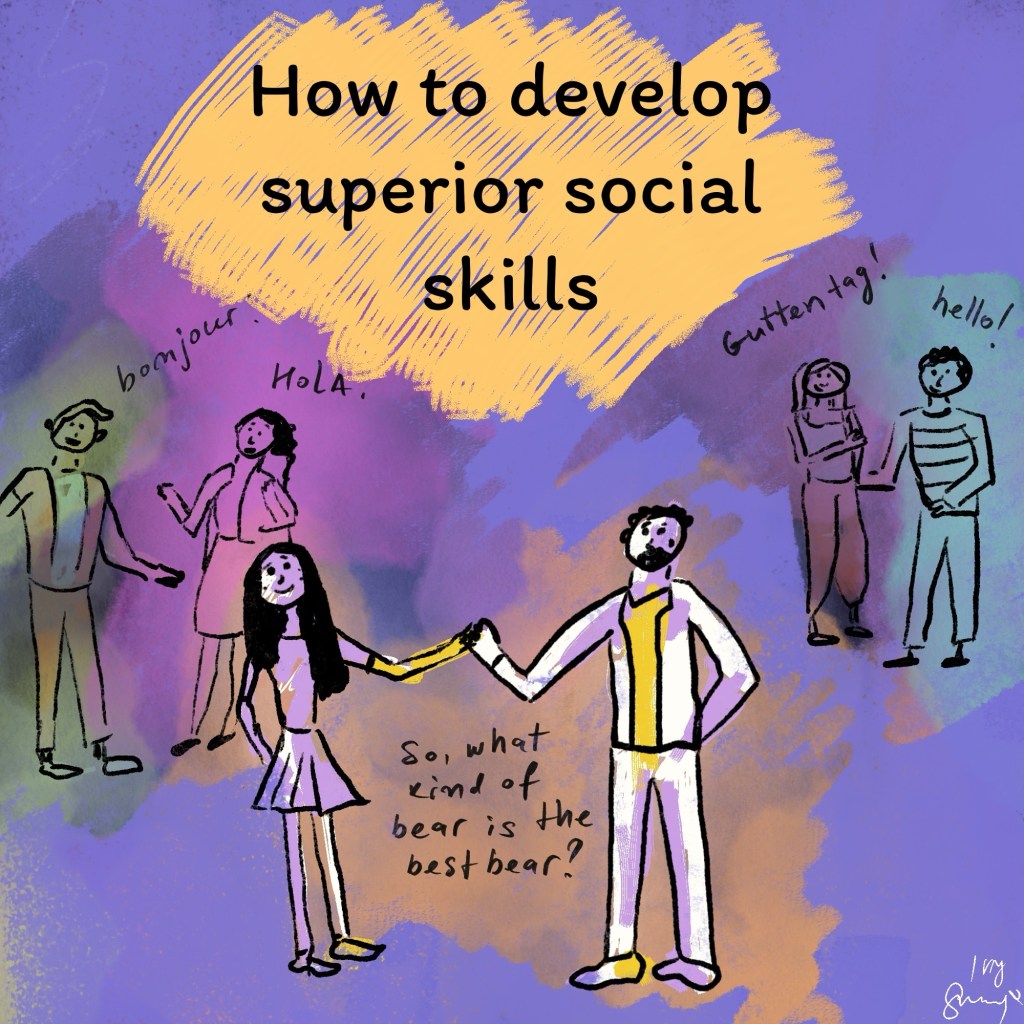
Mindset Over Matter
If you came to this article, I’d guess you’ve had enough of feeling awkward in social situations.
Maybe:
- that job interview didn’t go so well,
- all your friends are married and you’ve got no one to go on a trip with, or
- you have no idea how to approach that new love interest of yours.
Whatever it is, I got you. And I’m going to show you a simple, proven way to become genuinely confident in social situations.
Spoiler: it’s got nothing to do with following a boring checklist. Becoming good at communication isn’t as hard as you think.
Why Typical Advice Fails
If you’ve been out there Googling all those generic tips like:
“Build your confidence!”
“Engage with others!”
“Start small!”
…only to stay stuck, there’s a reason.
All of that advice assumes one thing – that you’re someone who struggles to socialize.
See the problem?
If you didn’t believe socializing was hard, you wouldn’t “start small.” If you already thought you were confident, you wouldn’t need to “build confidence.” You’ll keep struggling as long as you identify as “socially awkward.”
That’s the mental loop keeping you stuck.
I’m going to teach you the only effective way to gain social confidence, and how to do it with ease.
A Story About Social Anxiety
I used to see myself as a die-hard introvert.
Introversion isn’t an insult, it’s a personality trait. But like anything else, it becomes a problem when taken to extremes.
If you think you’re uncomfortable in social situations, hear me out.
I used to get so anxious about upcoming events – team buildings, presentations, Christmas parties, that it was all I thought about. My anticipatory anxiety was so bad that the day before, I’d actually vomit from the stress.
I dreaded going out with new people.
Once, a friend invited me camping for a full weekend with their group, and I nearly cried after saying yes out of politeness.
Dates? Forget it.
In group conversations, my voice was so quiet polite people asked me to repeat myself, while impolite ones just talked over me. Eventually, I stopped trying and just… listened. It got so bad people didn’t even notice if I was there, or think to invite me next time.
My social comfort zone? The size of a pinhead.
Sound familiar?
Now here’s the wild part – all of that changed in just one day.
Social Confidence Is Fluctuating
One day, during a random chat with my mom, she mentioned that I used to be an unusually sociable kid.
Apparently, I learned to read at two, and once I started talking, I never stopped. I’d walk up to total strangers and start chatting, leaving people both amused and impressed.
I didn’t think much of it at first.
But that same evening, I got a call from an old friend I hadn’t spoken to in years. We talked for over an hour.
What struck me most wasn’t the nostalgia, it was realizing how much he had changed.
Back in the day, he was the shy, quiet type, constantly overthinking what people thought of him. Because of that, he kept most things to himself, missed opportunities, and sometimes lashed out passive-aggressively when something bothered him.
He’d made some connections back then, sure, but nothing deep.
And now?
He was the total opposite – curious, funny, confident. He kept asking questions, switching topics, laughing, even interrupting me (in a good way). He completely owned the energy of our conversation.
So I started wondering: how did this guy transform into a communication master… while I, the former chatterbox, turned into someone who dreaded basic social interaction?
The reason should be obvious.
You Can Become Anything With Enough Practice
Social skills are trained by practice.
If kids were afraid to fall, we’d never learn to walk. But no kid is “bad” at walking, because they have no choice but to practice until it happens.
So why do extroverts seem to socialize effortlessly while introverts struggle to relax around people?
Here’s the truth: one type isn’t superior to the other.
Extroverts are energized by social interactions, while introverts are drained by them and recharge in solitude. The only difference? Extroverts have simply had more practice.
And the only way to feel at ease with something is, (you guessed it), practice.
You might say:
“But I don’t want to practice! I hate small talk. I don’t like loud parties or big gatherings. I don’t need to become someone I’m not!”
And that’s totally fine. You don’t need to do anything. But… wouldn’t it be nice if social interactions didn’t make you anxious?
Imagine never again feeling awkward because you had no one to hang out with. Imagine not obsessing over how to impress your crush because socializing just came naturally to you. You don’t have to love noisy crowds or constant interaction.
But I’m going to show you how socializing can be effortless, so when you do feel like going out and meeting people, absolutely nothing will hold you back.
Once you realize how easy it actually is, you’ll want to practice more, and before you know it, you’ll be a natural at it.
You might already be thinking, “Okay… but how do I do it?”
The Method Acting Technique
There’s a technique called method acting.
Actors use it to make their performances so believable that they become their characters – mentally, emotionally, and even physically.
They don’t just pretend to be someone else; they live as that person. They step into the character’s world, feel what they’d feel, and think how they’d think, until the transformation becomes second nature.
Now, if you really want to turn yourself into a social butterfly, here’s your challenge:
Think of it as a secret game that only you know the rules to.
You’re the actor, and your new role is “the heart of every company.”
Truth is… People LOVE Social People
Here’s the first thing you need to realise: most people love to communicate. We’re wired for it. Humans want connection.
So the next time you feel anxious in a social situation, remember: people aren’t judging you, they’re just waiting for someone to start the spark.
The harsh truth?
If people seem to ignore you or lose interest, it’s probably not because you’re boring, weird, or unworthy. It’s because you’re giving off a passive vibe, one that says “please don’t talk to me.”
Let’s break it down.
How a socially awkward person behaves:
- Avoids parties, group gatherings, or social games.
- Never starts the conversation first.
- Waits for others to “notice” them or make the first move.
- Keeps a closed-off posture: crossed arms, hunched shoulders, minimal eye contact.
- Speaks too quietly or mumbles.
- Keeps a neutral or even unintentionally grumpy expression (been there – people used to ask me, “What’s wrong?” constantly).
- Avoids meeting new people like the plague.
- Overthinks every single thing they might say, and ends up staying silent.
Now compare that to the opposite energy:
How a socially confident person behaves:
- Goes out of their way to meet new people.
- Starts the conversation – even with the shy ones hiding in the corner.
- Speaks with a strong, clear voice.
- Organises gatherings, get-togethers, or casual hangouts.
- Keeps the conversation flowing, jokes around, shares opinions freely.
- Invites people for coffee, lunch, tennis, whatever.
- Doesn’t overthink. Just talks.
Now that we’ve got the contrast crystal clear, let me tell you what happened the day I decided to put the Method Acting trick into practice.
Putting Socialising into Practice
NB: By the time I tried this little “social experiment,” my social anxiety was so bad I realised I only had one friend left, (the kind you see once a week out of sheer loyalty).
So… I decided to get to work.
Normally, when I met my boss in the morning, our interaction went like this:
“Good morning.”
“Morning.”
Crickets.
He wasn’t the most socially confident person either, so we were basically two introverts politely avoiding eye contact.
But that morning, I decided to flip the script.
Not only did I say “Good morning,” but I kept going: chatting about the weather, the news, and asking if he’d tried that new medical platform he mentioned last week.
After five minutes of small talk, I could actually see him light up. He looked genuinely pleased that I’d approached him, which made me realise how unfriendly I must have looked before.
That small success gave me fuel.
Next stop: the office kitchen. Normally, I’d make coffee and quietly vanish.
This time, I opened my mouth – complimented a coworker’s new dress, joked about how our new coffee machine sounded like a rocket launcher… and guess what?
Nobody brushed me off.
Nobody gave a polite, short answer.
Every single person’s face lit up.
Because here’s the truth: people love to socialise. Even the quiet ones.
You’re Overestimating Other People’s Confidence
At lunch, I joined a group of colleagues I wasn’t close with.
They’d been eating together for months, yet there were still those awkward silences – everyone poking at their salad, no one talking.
So I thought, “Alright, what’s the worst that could happen?” and decided to fill the gap.
I tossed out a random comment about The Bachelor from the night before.
Yes, I thought they might think I was dumb or weird… but I didn’t care anymore.
And then something amazing happened – the entire table came alive!
They started talking about the contestants, sharing opinions, debating types – it turned into a full-on, hilarious conversation.
Turns out, you never know how even the dumbest topic can bring people together.
And the cherry on top?
People who’d never invited me anywhere before started asking me out for lunch every Friday.
All because I dared to open my mouth first.
Try This for One Week
- Approach people before they approach you (This one’s crucial, it flips the social script instantly).
- Keep talking – Doesn’t matter if it’s small talk, random thoughts, or compliments. The more you talk, the easier it flows.
- Purposely act out of character (Pretend you’re the outgoing version of yourself. Laugh in your head and think, “Wow, I’m killing this role.”)
- Share bits of your day – Mention something funny that happened, a show you watched, your morning coffee disaster, whatever.
- Own your space – Straight posture, open shoulders, clear voice. Don’t sit like you’re apologizing for existing. Take space.
- Eye contact and a smile – Simple, but lethal in the best way possible.
Here’s the best trick I can give you:
When you talk to anyone, imagine they’re the shy one – and you’re the one helping them relax.
That single switch changes everything.
Because guess what?
Most people aren’t half as confident as you think.
They’re just as self-conscious about how they look, how they sound, and whether they said something dumb.
So next time you’re sweating over what to say, remember, the person in front of you is probably doing the same.
When you stop worrying about looking silly, people think,
“Wow, this person is so easy to talk to. I never feel awkward around them.”
And that’s when it clicks – socialising isn’t hard at all.
Once you know you can do it, you won’t stress about it anymore.
You can chill by yourself or walk into a crowd, either way, you’ve got this.
Because now you know… socialising is a piece of cake.
Did this advice help you?
Share your experiences in the comments, I’d love to hear how your “social experiment” goes!
See more:
Signs you may have anger issues
How to make your life interesting and exciting
TheThinkAbout is a website based on psychology in practice and experience.
Like the articles? Subscribe to never miss anything.
Your contribution matters! If you find this website helpful, please support our work. Thank you for visiting!
 The think about
Leave a comment